- Why dive here
- Guam
- Saipan
- Tinian and Rota
- Best snorkelling spots from the shore
- Seasons and conditions
- Safety and good practice
Why dive here
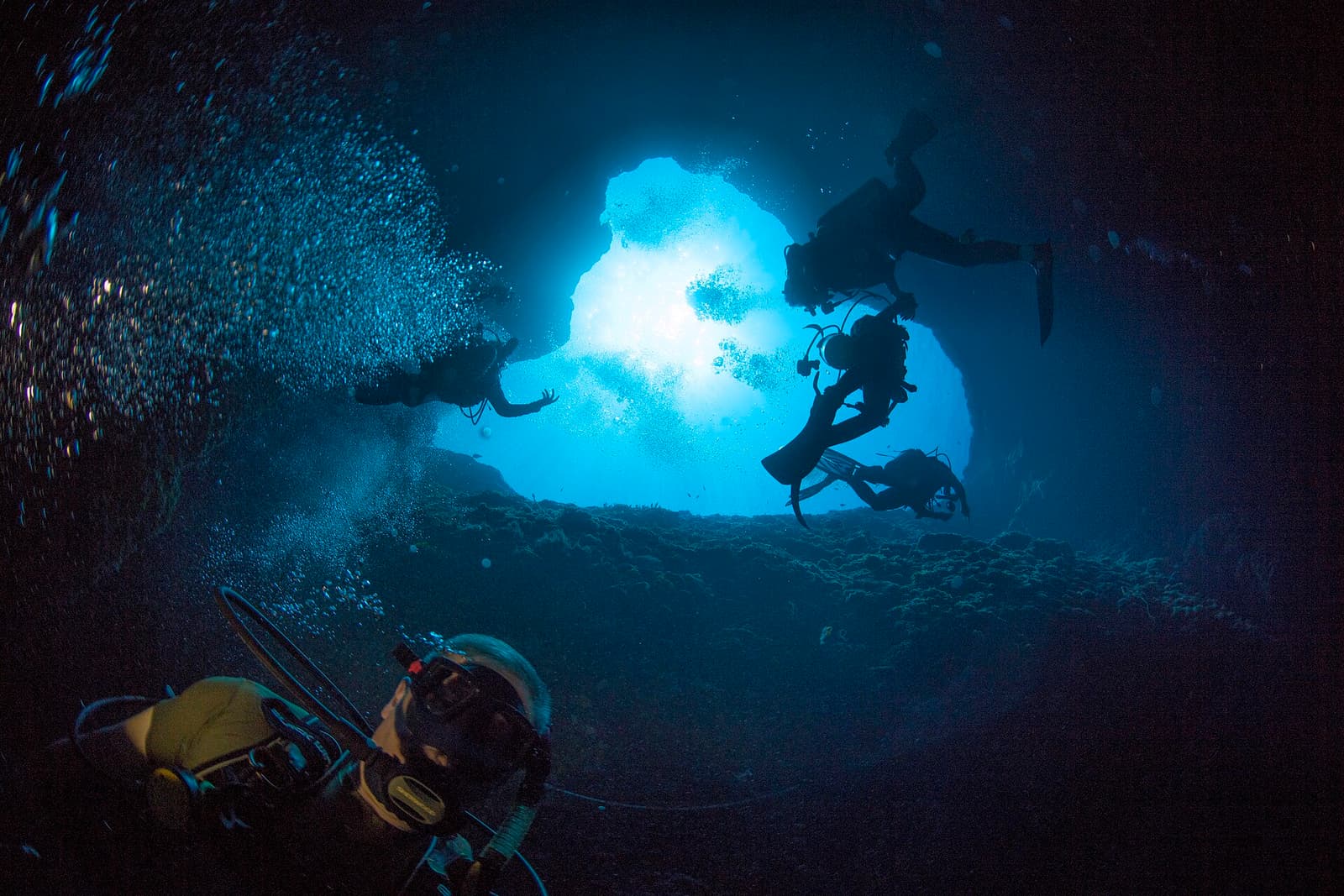
The Marianas do not have the sheer biomass of Palau or Raja Ampat, and it is fair to say so. What they offer instead is ease and variety: water of 27–30 °C all year, visibility commonly 20–40 metres (and more around Rota), short boat rides, excellent shore diving, a remarkable collection of wrecks from two world wars, and dramatic limestone architecture — sinkholes, caverns and tunnels lit by shafts of blue light. Dive centres on Guam and Saipan teach in English, Japanese, Korean and Chinese, which makes the islands one of the most popular places in the region to learn.
Guam
Apra Harbor is the wreck capital. The Japanese freighter Tokai Maru, sunk in 1943, lies against the German auxiliary cruiser SMS Cormoran, scuttled in 1917 — widely described as the only place where a diver can touch wrecks from both world wars at once. Other harbour dives include an American tanker and a “junkyard” of dumped Seabee equipment. Outside the harbour, the Blue Hole on the Orote Peninsula is a natural shaft that drops through the reef from about 18 metres to a window on the open wall far below, and nearby sites such as the Crevice and Barracuda Rock offer walls and the chance of larger fish.
From the shore, the Piti Bomb Holes marine preserve is the classic beginner site, with an underwater observatory at Fish Eye Marine Park; Tumon Bay and Ypao Beach give effortless snorkelling in front of the hotels; and Gun Beach and several west-coast reefs suit confident snorkellers on calm days. Guided snorkelling at Piti and an introductory shore dive are among the handful of activities bookable on GetYourGuide.
Saipan
The Grotto is Saipan’s signature dive: a collapsed cavern reached by a long flight of steps, with three underwater passages leading to the open sea and a blue glow that photographers love. It demands respect — surge at the entry rock injures people every year — and should be done with a local guide in calm conditions. See northern Saipan.
Lau Lau Bay on the east coast is the island’s training ground and a fine shore dive in its own right, with turtles and schooling fish. Obyan Beach in the south has gentle slopes of white sand and coral facing Tinian. By boat, sites off the west coast include a coral mound nicknamed Ice Cream, known as a cleaning station for eagle rays, and several Second World War wrecks in the lagoon — a Japanese freighter, a flying boat and others — shallow enough for snorkellers and marked as a maritime heritage trail. Managaha Island is the easiest snorkelling of all.
Tinian and Rota
Tinian is dived mostly by boat from Saipan or with the island’s own small operators: its own grotto, a cove where wartime equipment was dumped, and reefs that see very few divers.
Rota is the connoisseur’s choice. With no rivers and almost no development, the water in Sasanhaya Bay is extraordinarily clear. The highlights are Senhanom Cave — often called the Rota Hole — where a column of sunlight falls through an opening in the roof, and the wreck of the Japanese freighter Shoun Maru, sunk in 1944. Operators are few, so arrange dives before booking flights. See Rota.
Best snorkelling spots from the shore
All of these can be reached without a boat except Managaha. Bring your own mask if you can; hire gear is available at the main beaches on Guam and Saipan but not on the outer islands.
| Spot | Island | Why go | Conditions |
|---|---|---|---|
| Tumon Bay & Ypao Beach | Guam | Marine preserve in front of the hotels; plenty of fish in shallow water | Calm almost always; very shallow at low tide |
| Piti Bomb Holes | Guam | Sinkholes in the reef flat, soft corals, guided tours available | Calm; a swim out over shallow reef |
| Managaha Island | Saipan | Clear water, roped swimming area, lifeguards | Calm; boats stop in rough weather |
| Pau Pau Beach | Saipan | Quiet lagoon beach with coral close in | Calm; shallow |
| Obyan Beach | Saipan | White sand and coral facing Tinian | Calm days only; remote |
| Tachogna Beach | Tinian | Easy entry, hardly anyone there | Usually calm |
| Teteto Beach | Rota | Shallow reef flat with very clear water | Calm days; no facilities to speak of |
Seasons and conditions
You can dive every month. The calmest seas and best visibility usually come from about March to June. From December to February the trade winds roughen the east and north coasts, while the western lagoons and Apra Harbor stay sheltered. In the wet season, rain run-off can cloud inshore water on Guam for a day or two, and distant storms send swell that closes exposed sites such as the Grotto. A 3 mm suit or a rash vest is all most people need.
Safety and good practice
- Dive and snorkel with a local operator at any site involving caverns, surge or current — above all the Grotto, the Blue Hole and anything outside the reef.
- Stay inside the reef when snorkelling from the beach, and keep away from channels.
- Look, do not touch. Wrecks here are protected war graves and historic sites; taking artefacts is illegal. Unexploded ordnance is still found under water.
- Respect the preserves. Tumon Bay, Piti and other areas on Guam, and Managaha, Bird Island and Forbidden Island in the CNMI, are protected: no fishing, no collecting, no feeding.
- Insure yourself. Make sure your policy covers diving and evacuation; recompression facilities in the region are limited, and you should ask your dive centre what is currently available.
- Leave 18–24 hours between your last dive and any flight — including the small inter-island planes.