- The first islanders
- Spain and the galleons (1521–1899)
- Divided islands (1898–1941)
- The Pacific War (1941–1945)
- Since 1945
- Living culture
- A short timeline
The first islanders
People reached the Marianas around 3,500 years ago, sailing from island South-East Asia across some 2,000 kilometres of open ocean — one of the longest sea crossings anyone had made at that time. Their descendants are the Chamorro (spelt CHamoru on Guam), the indigenous people of the whole chain.
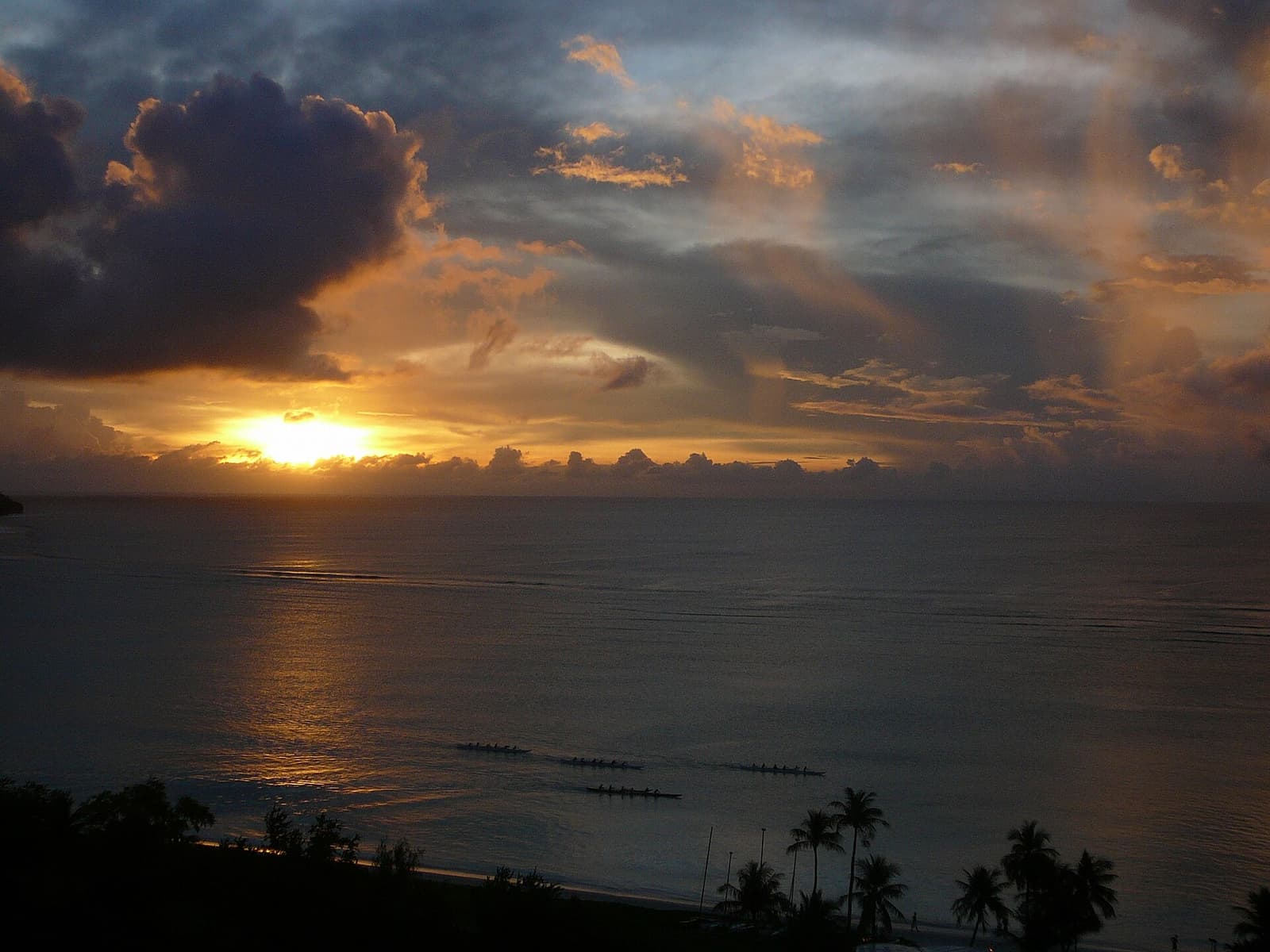
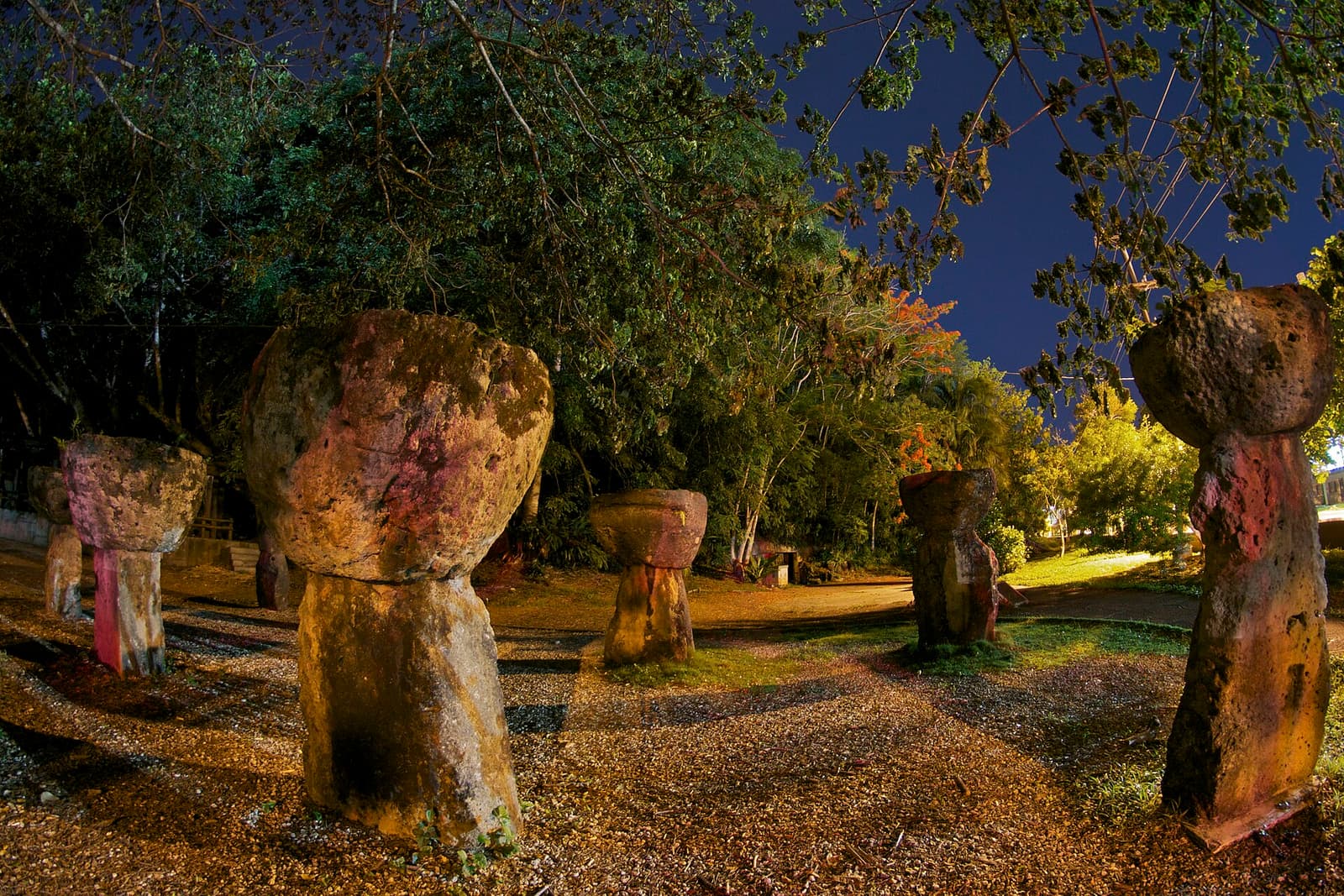
From roughly a thousand years ago they built houses raised on latte: paired rows of stone pillars, each topped with a hemispherical capstone. Latte are found nowhere else in the world and have become the emblem of the islands. Early European visitors were equally struck by the Chamorro “flying proa”, an outrigger sailing canoe faster than any ship they knew. Society was organised in matrilineal clans, and values such as inafa’maolek — making things good for one another — still shape island life.
See it: Latte Stone Park and the Guam Museum in Hagåtña; the House of Taga on Tinian; the latte quarry on Rota; rock art at Ritidian in northern Guam.
Spain and the galleons (1521–1899)
Ferdinand Magellan’s ships reached the islands in March 1521, the first European landfall in the Pacific. Spain claimed them in 1565 and colonised them from 1668, when the Jesuit Diego Luis de San Vitores founded a mission on Guam and named the archipelago after Queen Mariana of Austria. Decades of resistance, warfare and epidemics followed; the population collapsed, and the survivors of the northern islands were resettled on Guam. For two centuries Guam was a provisioning stop for the Manila–Acapulco galleons.
In the early 1800s, Carolinian navigators from atolls to the south, whose homes had been wrecked by typhoons, settled on Saipan with Spanish permission. Their descendants, the Refaluwasch, are the CNMI’s second indigenous community.
See it: the Plaza de España in Hagåtña; Fort Nuestra Señora de la Soledad and Umatac Bay in southern Guam; Chief Aghurubw’s memorial on Managaha Island.
Divided islands (1898–1941)
The Spanish–American War split the Marianas. The United States took Guam in 1898 and ran it as a naval station. Spain sold the northern islands to Germany in 1899; Japan seized them in 1914 and governed them under a League of Nations mandate. Under Japanese rule Saipan, Tinian and Rota were transformed by the sugar industry, and tens of thousands of settlers from Japan, Okinawa and Korea came to outnumber the islanders.
See it: Sugar King Park and the old Japanese hospital in Garapan; sugar-mill and railway relics on Rota; Japanese-era ruins in San Jose on Tinian.
The Pacific War (1941–1945)
Japanese forces took Guam within days of the attack on Pearl Harbor in December 1941 and occupied it for two and a half harsh years. In June 1944 the United States launched its Marianas campaign. Saipan was invaded on 15 June and fell on 9 July after one of the bloodiest battles of the Pacific; in its last days hundreds of Japanese civilians and soldiers took their own lives at the northern cliffs. Guam was retaken between 21 July and 10 August, and Tinian between 24 July and 1 August. Rota was bypassed and surrendered at the end of the war.
The islands then became bases for B-29 bombers. From North Field on Tinian, then the busiest airfield in the world, the Enola Gay and Bockscar took off in August 1945 carrying the atomic bombs dropped on Hiroshima and Nagasaki.
See it: War in the Pacific National Historical Park at Asan on Guam; American Memorial Park, the landing beaches, the Last Command Post, Banzai Cliff and Suicide Cliff on Saipan; the bomb pits and runways of Tinian. Please treat all of these as memorials.
Since 1945
Guam became an organised US territory in 1950, and its people US citizens. The northern islands were administered by the United States as part of a United Nations trust territory until their people voted for union with the US; the Commonwealth of the Northern Mariana Islands came into being in 1978, and its residents became US citizens in 1986. The last Japanese soldier in hiding on Guam, Sergeant Shoichi Yokoi, was found in the jungle in 1972.
Today the US military occupies a large part of Guam and has leased much of Tinian, while tourism — chiefly from Japan, Korea and, on Saipan for a time, China — is the mainstay of the civilian economy on both sides of the political line.
Living culture
Centuries of outside rule changed the Marianas but did not erase them. Chamorro and Carolinian are official languages alongside English; the islands are strongly Catholic, and the calendar turns on village fiestas at which anyone may be fed. Recent decades have brought a deliberate revival of chant, dance, weaving, traditional seafaring and navigation, and the indigenous languages are taught in schools.
The easiest ways in for a visitor are the Wednesday night market at Chamorro Village in Hagåtña, the cultural dinner shows around Tumon, the cultural village at Inarajan when it is open, Saipan’s Flame Tree Arts Festival and street market, and — best of all — a fiesta, if your dates coincide with one. A few customs worth knowing are in our travel guide.
A short timeline
Dates are those generally given by historians; archaeological dates in particular are approximate.
| When | What happened |
|---|---|
| About 1500 BCE | First settlers arrive by sea from island South-East Asia |
| About 900–1700 CE | The latte period |
| 1521 | Magellan’s expedition reaches the islands |
| 1668 | Spanish mission founded on Guam; the islands are named the Marianas |
| Early 1800s | Carolinians settle on Saipan |
| 1898–1899 | Guam passes to the United States; the northern islands to Germany |
| 1914 | Japan takes the northern islands |
| December 1941 | Japan occupies Guam |
| June–August 1944 | Battles of Saipan, Guam and Tinian |
| August 1945 | Atomic bomb missions fly from Tinian |
| 1950 | Guam becomes an organised US territory |
| 1978 | The Commonwealth of the Northern Mariana Islands is established |